
Right now there’s real pressure to learn AI, implement AI, and become an “AI-first” business. It’s coming at you from every direction. Spend ten minutes online and you’ll find two camps feeding that pressure from opposite ends. One says AI is coming for your job, your business, and possibly civilization while it’s at it. The other says if you’re not already running an AI powered team of digital employees, you’re already behind and should probably panic about that, too.
Both camps are selling something. Usually attention. Sometimes a course. The truth, like most truths, lives in the murky middle. Everyone’s too busy shouting and waving their arms around to notice and something important is getting lost in the shuffle.
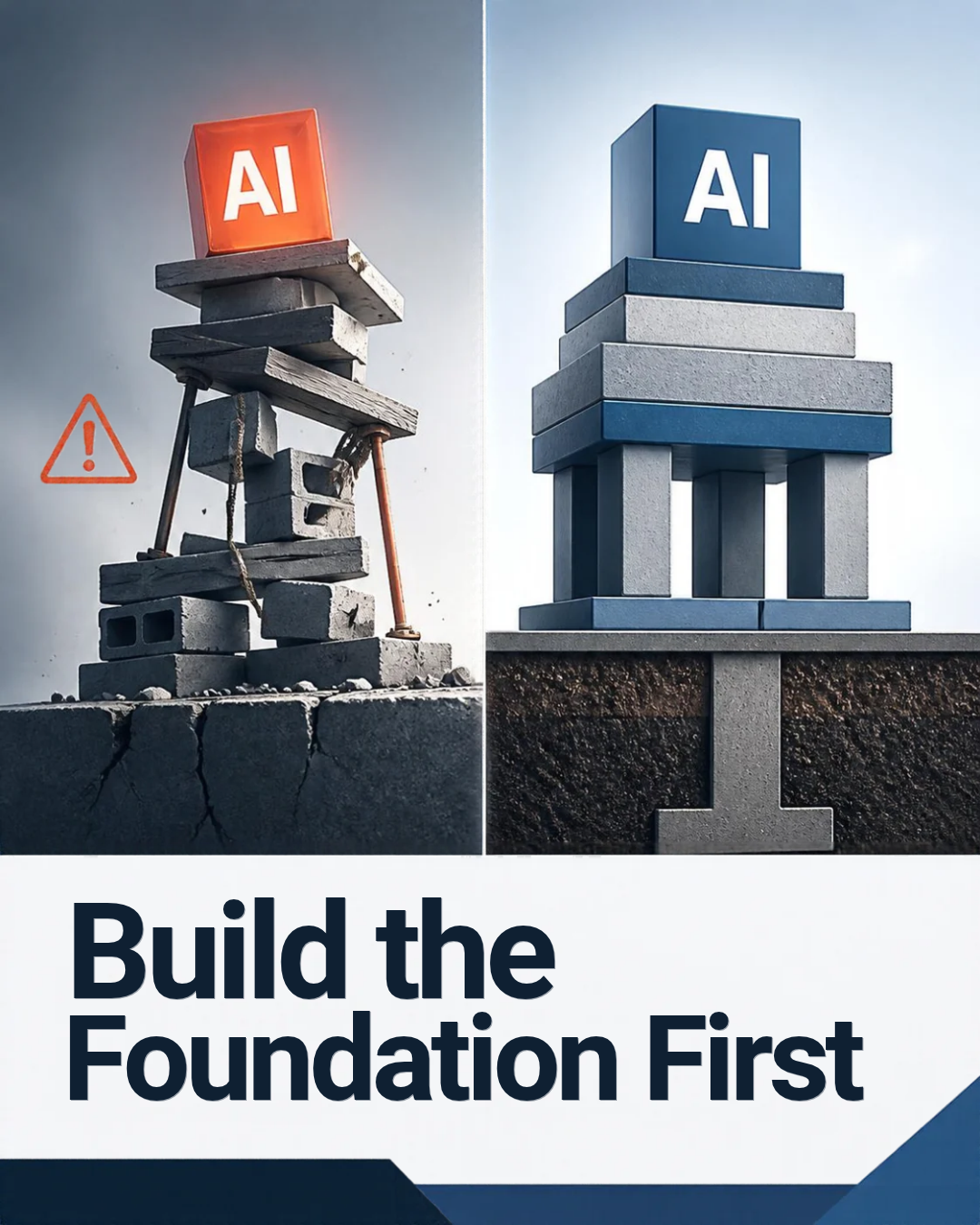
The real risk isn’t picking the wrong side of the AI debate. It’s rushing to adopt AI (or related tools and tech), or refusing to touch it out of fear, before you actually have command of the fundamentals your business runs on. Skip that step and it doesn’t matter how sophisticated the tool is. You can’t build effectively, you can’t scale correctly, and none of it holds up long enough to be stable and sustainable.
The Prerequisite Nobody’s Talking About
Whether you’re racing to bolt AI onto every part of your business or holding out as long as you can, the mania is pointing you at the wrong question. It’s not “how fast can I get on board.” It’s “do I actually have command of the basics this business is built on.” Skip that question and it doesn’t matter which side of the AI debate you’re on. You’re building on ground that won’t hold the weight.
What a Foundation Actually Looks Like
Foundation isn’t a buzzword here. It’s the boring stuff, the basics you need full command of before anything else works. In practice, it looks like:
- A documented process for how someone becomes a client, from first contact through onboarding
- Offerings that are clear enough to explain without a 30 minute call
- Operations that don’t depend entirely on your memory, or your assistant’s inbox
- Systems that keep functioning when you’re on vacation, sick, or just having an off week
Technology, including AI, amplifies whatever is already there. Layer AI onto a process you haven’t nailed down and you don’t get an efficient process. You get the same gaps and guesswork, just faster and harder to catch. You end up with something that looks impressive from the outside and can’t actually scale, because nobody, including you, has full command of how it actually runs underneath.
Four Things That Matter More Than Implementing AI Right Now
Skip the hype for a second and ask yourself these questions instead:
- Do I have a documented, repeatable process for the thing that actually makes me money?
- Could someone else run this business for two weeks if I disappeared?
- If I added a new tool tomorrow, would it be organizing something that already works, or papering over something that doesn’t?
- AND…the one that is often overlooked – if I implement new technology, do I and my staff have the skillset to manage and maintain it effectively?
If you can’t answer all these with confidence, that’s not a reason to avoid AI forever. It’s a sign of exactly where to start instead.
The Bottom Line
The businesses that come out ahead over the next five years won’t be the ones who correctly predicted whether AI is good or bad. They’ll be the ones who built something solid enough to survive being wrong either way. That’s not a hot take. It’s just how foundations work, with or without a robot’s help.
Action Item
Your move. Email me at robin@pivotsytems.io with one challenge: What’s the one thing in your business that you know isn’t working but you haven’t documented yet — the process that lives in your head, or your assistant’s email, or nowhere at all? Tell me what it is and why it matters. I’ll point you toward where to start.
The Bottom Line
Skip the debate. The businesses that pull ahead aren’t the ones who bet correctly on whether AI is good or bad. They’re the ones who built something solid enough to work either way — with or without it. That’s not a hot take. It’s just how durability works. And right now, durability is the competitive advantage everyone’s overlooking while they’re arguing about the shiny thing.