Doing Nothing Is a Decision
I’ve been thinking about something I hear a lot: “I’m just not a tech person.”
Here’s the thing – you don’t need to be a tech person, but you ARE making technology decisions every single day.
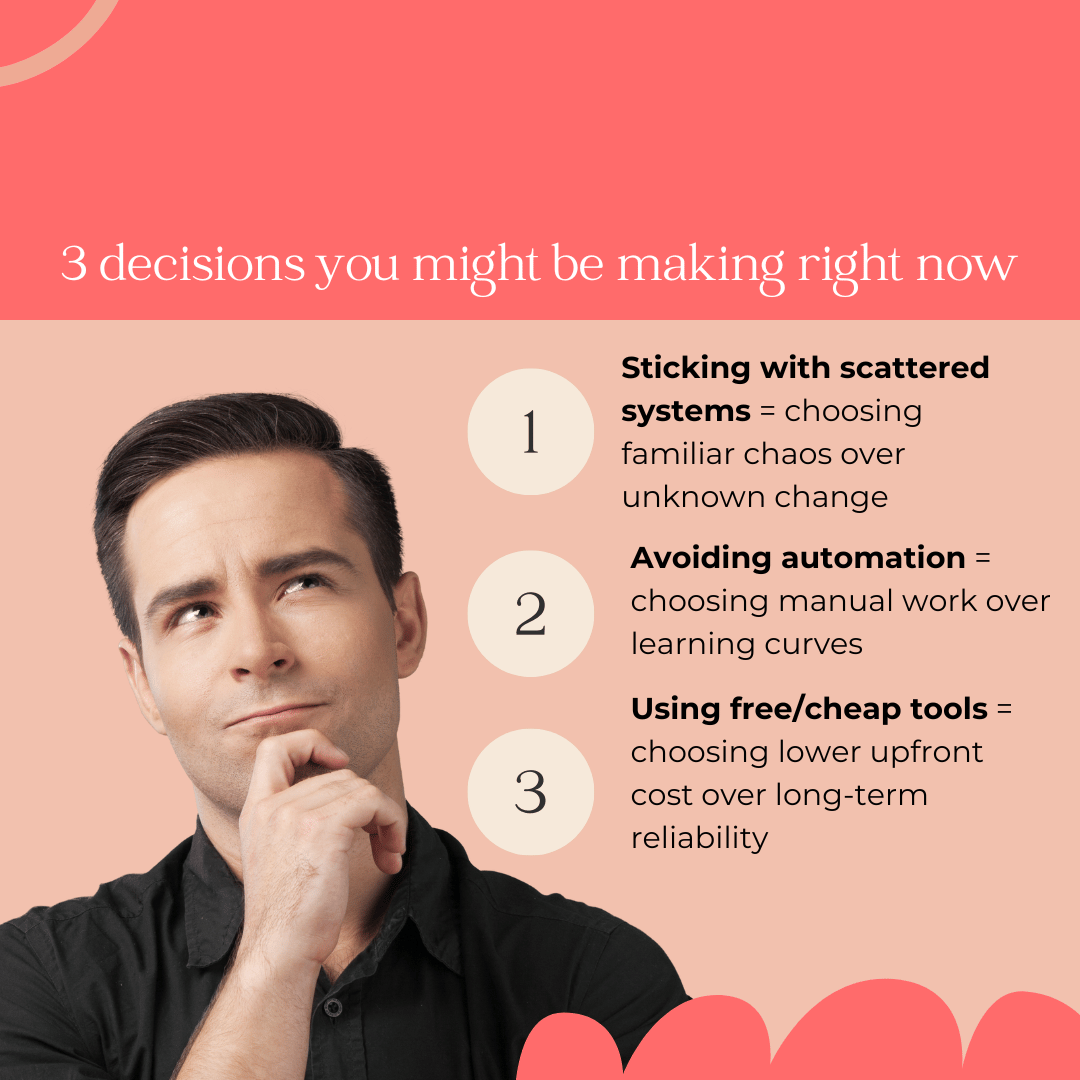
- Sticking with that scattered system of spreadsheets and email? Decision.
- Avoiding automation because it feels complicated? Decision.
- Using free tools held together with digital duct tape? Decision with consequences.
Even doing nothing is still a decision.
The Hidden Risk Management Game
Let’s be honest – my job title says I help with digital systems and data flows. But here’s what I actually spend most of my time doing without talking specifically about it: risk and opportunity management.
Because that’s what digital foundation decisions really are, stripped of all the technical jargon.
When a client tells me “We’re fine with how things work now,” what they’re really saying is: “We’ve decided the risk of change feels bigger than the risk of staying put.”
But staying put isn’t risk-free. It’s just familiar risk.
What “Doing Nothing” Actually Costs
Opportunity cost: While you’re manually updating three different spreadsheets, your competitor is serving two more clients with automated workflows.
Resilience cost: When your “system” is you remembering everything, what happens during your family emergency or that week you get sick?
Growth cost: Those workarounds that handle 20 clients fine? They break completely at 50 clients, creating an invisible ceiling on your business.
Mental energy cost: The cognitive load of maintaining scattered systems drains strategic thinking capacity you don’t even realize you’re spending.
Here’s the thing…
Let’s admit it – this is a crazy time right now. In the scramble to take advantage of the artificial intelligence (AI) gold rush, many are advising that clients jump straight to solutions. I’m all about technology but I disagree with this approach. Before you integrate anything, you need to understand what you’re actually managing.
Three questions that change everything:
1. What’s your risk tolerance? Are you more afraid of change or of being left behind?
2. What’s your real constraint? Time, money, technical knowledge, or decision fatigue?
3. What would failure cost you? Not just money – relationships, reputation, peace of mind.
Your answers determine your foundational strategy.
Conscious Choice vs. Default Drift
The business owners who thrive aren’t the ones with the fanciest tech stacks. They’re the ones making conscious choices about their digital foundation and the future of their business.
Conscious choice: “We’re using this cobbled system for now because we’d rather invest in client delivery, but we’ll revisit in Q1 when we have more capacity.”
Default drift: “This is just how we’ve always done things.”
Both might look the same from the outside, but one has intentionality and an exit strategy.
Your Business, Your Rules
You get to choose your level of digital sophistication based on YOUR priorities, not what some guru says you “should” be doing.
Maybe you consciously choose simplicity because your energy is better spent on client relationships. Maybe you invest heavily in automation because you have the technical skill set needed to do it effectively + you value freedom and scalability.
Both can be smart choices when made intentionally.
The Bottom Line
Every day you don’t address your digital foundations, you’re making a choice about what risks you’re willing to accept and what opportunities you’re willing to miss.
The question isn’t whether you’re making technology decisions. The question is whether you’re making them consciously.